
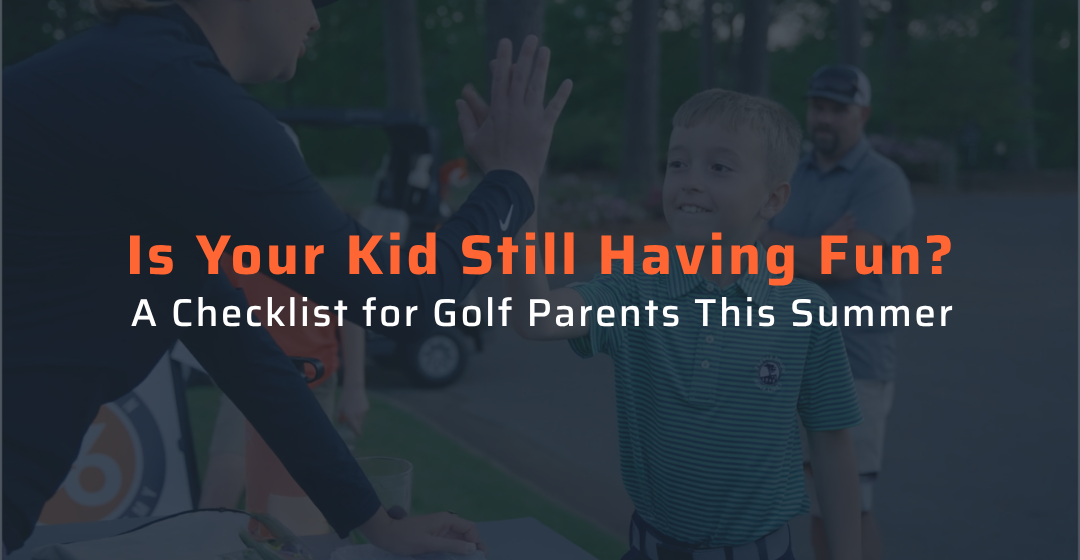

Is Your Kid Still Having Fun? A Checklist for Golf Parents This Summer
Summer golf season is here. The schedule is full, the tee times are booked, and levels are moving. It's exciting — and exhausting — and for a lot of golf families, it's the most intense stretch of the year.
In the middle of all of it, there's one question worth asking that often gets overlooked: Is your kid still having fun?
Not "are they improving?" Not "are the scores heading in the right direction?" Those are valid questions. But they're different from this one. And right now, in the heat of summer, this is the one that matters most.
What burnout actually looks like
Junior golf burnout rarely announces itself. It doesn't usually show up as a dramatic breakdown or a tearful "I quit." It shows up quietly — in the small things you might chalk up to a bad week or a rough patch.
Here's what the research, coaches, and sports psychologists say to watch for:
- They used to talk about golf after a round — good shots, funny moments, what they want to work on. Now they go quiet.
- Getting ready for practice feels like pulling teeth. There's always a reason to delay, skip, or cut it short.
- They're irritable after rounds in a way that feels different from normal competitive disappointment.
- Sleep is off — harder to fall asleep, harder to wake up, more tired than usual.
- School performance is slipping alongside golf performance at the same time.
- They've stopped setting goals or talking about the future of their game.
- The game feels like an obligation, not a choice.
None of these alone is a red flag. But if several of them are showing up together, consistently, over a few weeks — that's worth paying attention to.
The pressure problem parents don't see
Here's something hard to hear: most golf parents who are pushing too hard don't know they're doing it. They're not being cruel. They're being invested. They care deeply, they've given a lot, and they want to see their kid succeed. That's love — but it can look like pressure from the other side of the cart.
Sports psychologist Dr. Gregg Steinberg puts it plainly: fun and anxiety don't mix. A child who feels watched, analyzed, and evaluated after every shot is going to associate the game with stress — not joy. And when the joy goes, everything else follows.
One college coach described a talented junior golfer who lost their love for the game because their parent analyzed every round with a clipboard in hand. Rather than celebrating progress, the child felt like every round was a test.
The AAP (American Academy of Pediatrics) recommends that young athletes take two to three consecutive months off from their primary sport each year. Not because rest is a retreat, but because it protects the long game. Kids who play year-round with no off-season don't develop more. They burn out faster.
Three things you can do right now
1. Ask a different question after a round. Instead of "how did you hit it?" or "what happened on 5?" try "did you have fun today?" and then actually listen to the answer. If the answer is consistently no — or a flat "it was fine" — that's information.
2. Let them set the tone on practice days. Give your junior golfer some ownership over what they work on. A kid who feels in control of their development is far less likely to burn out than one who feels like they're executing someone else's plan. The goal is a self-motivated golfer, not a compliant one.
3. Make space for golf that isn't competitive. A casual nine holes with no scorecard. A trip to the putting green just for fun. A round with friends where nobody's keeping score. Some of the most important golf a kid plays has nothing to do with levels. It's where the love of the game gets reinforced — or quietly rebuilt.
The golfer you're raising is more important than the score
Nearly 70% of kids in organized sports quit by age 13. Not because they weren't talented — but because they stopped enjoying it. Junior golf is not immune to that statistic.
The families who produce golfers who play into their 20s, 30s, and beyond are almost never the families who pushed hardest in the junior years. They're the ones who kept the game fun, stayed curious about their kid's experience, and treated every season as part of a much longer story.
Your kid's best golf is still ahead of them. Protect the foundation it's built on.
Being a great golf parent is one of the most impactful things you can do for your junior golfer's development. Learn how Operation 36 supports both junior golfers and the parents behind them — with a structured, confidence-first approach that keeps the game fun from the very first round.