I'm trying to get my 6 year old into baseball right now, and every single league in our area makes him try out. Try out. For a rec league. At six years old. I remember thinking, how did we get here? Why isn't there just a version where I sign my kid up and he's in?
But that's youth sports right now. And it made me think about golf, because we actually have the opposite problem. Nobody has to try out for anything in golf. The problem is we never built the thing that comes after you show up.
Every Other Sport Gives You a Reason
Here's what I mean. Dance has recitals. Gymnastics has meets. Even backyard baseball eventually turns into an actual game. Every one of those sports gives a kid a reason for why they're doing the repetitive, sometimes boring work of getting better. There's a narrative. You know what you're working toward, and you can see yourself getting there.
Golf never built that narrative. For years our answer has been, come take five lessons, or drop into a clinic whenever you feel like it. There's no plan, no next step, no way to know if you're actually improving. So the kid tries golf, has an okay time, and then never comes back, and everyone says golf isn't fun. It's not that golf isn't fun. Fun is seeing yourself get better. Fun is having a plan and then watching it work. Nobody ever gave people that in this sport.
What We Actually Built
That's really the whole reason Operation 36 exists. It took us fifteen years to build, and honestly the first five or six were just us figuring out what a real skill model for golf even looks like, because nobody had ever done it. Dance studios and gymnastics gyms figured this out a long time ago. Walk into one and they have a plan for your kid. They know it takes time to become a good dancer or a good gymnast, so they build you a path and get you repeating the same things over and over until you're actually good.
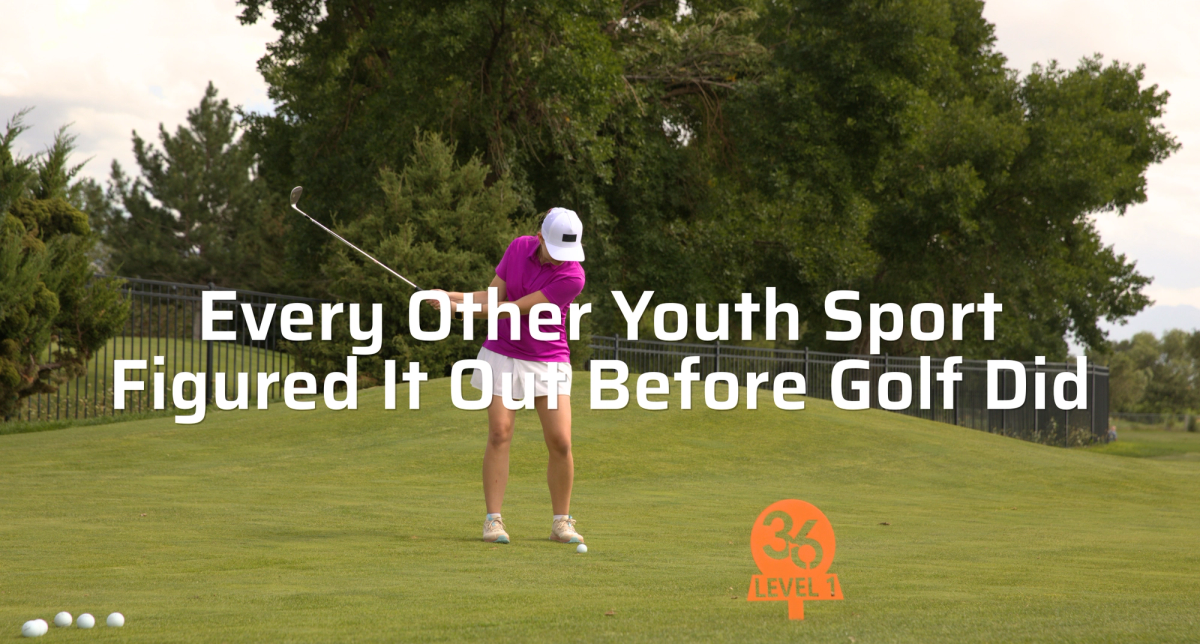
We built the same thing for golf, just structured around our own narrative. Everyone starts close to the hole, tries to shoot 36, and then just tries to beat that score by one. That's it. It's not about beating anybody else. You're in a room full of other people all chasing their own number, encouraging each other, but the only person you're actually competing against is the version of yourself from last week. Once you shoot 36 or better, we move you back a tee. It's simple, but it gives every single class a purpose. You showed up, you learned something, you took it to the course, and you can point to the number that proves it worked.
The Plan Isn't Enough on Its Own
The environment matters as much as the plan does, too. It's not enough to just teach the swing. You have to get people actually playing, because that's the part that hooks you. We joke about this every year, what if you learned baseball by only ever playing catch in the backyard and never played an actual game? That's most of golf instruction. Great swing, no game. The whole loop has to be there. Weekly classes with a coach, a social piece so you're learning alongside other people, and then getting out on the course and applying it. Take any one of those pieces out and the sport starts to feel pointless.
What to Look For If You're Building This
If you coach or run a facility, here's the practical version of everything I just said. Look at your program the way a gymnastics studio looks at theirs. Can a parent see an actual plan on day one? Is there a next step after the first few weeks that isn't just sign up again if you want? Can a kid point to something concrete that proves they're improving? If the answer is no to any of that, you don't have a program. You have a clinic, and clinics don't build lifers.
Why I Actually Care About This
I think about this as a parent now too, with a 6 year old and a 9 year old. Every other sport my kids could play has a shelf life. Most of the kids playing travel soccer or gymnastics right now won't be doing it in ten years. Golf is the one sport where all I actually want, long term, is for my kids to still be playing it with me when they're 30. That only happens if the early experience gives them a real reason to stick with it, not just a swing tip and a see you next time.
We spent fifteen years building that reason. If you're building a program right now, that's where I'd start.