
Somewhere last week, a nine year old walked off the ninth green, looked at her scorecard, and saw a number smaller than the one she wrote down in the spring.
She held the card up for her coach. He'd been waiting on that number all summer. And before they'd even left the green, she was already asking when she gets to play nine again.
That little gap between the old number and the new one is a stroke saved. Add up every one of them, across every Operation 36 player who has ever scored a round in the app, and you land somewhere north of a million.
A million is a hard number to feel. So look at a few golfers instead.
Meet Paxton, and his 41 strokes
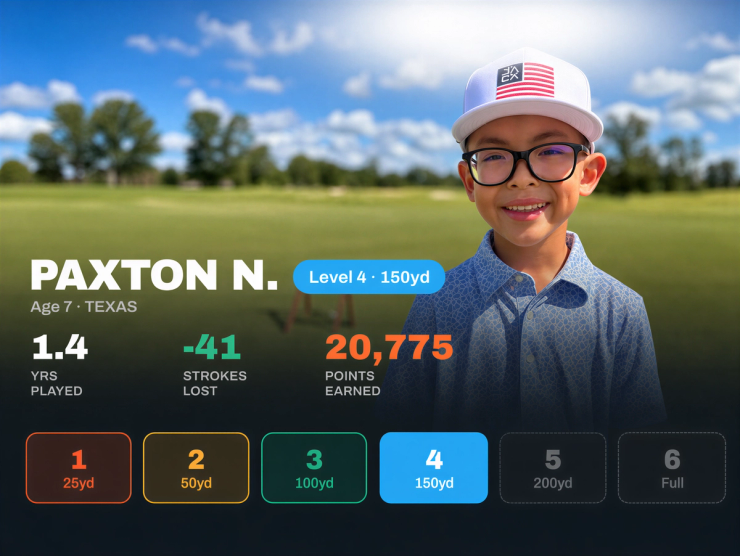
Paxton is 7. He's from Texas. He's been playing for a year and four months, he's up to Level 4 at 150 yards, and he has taken 41 strokes off his scores.
Here's how that number gets built. The first round a player scores at a level becomes their baseline, no judgment attached. Then they play. When their best round at that level beats the baseline, the difference is theirs to keep. Shoot 36 or better for nine holes and they move back to a longer distance and start the whole thing again.
Nobody self reports it. It comes from real rounds, on a real course, with a real scorecard. Which means Paxton didn't just take lessons for 16 months. He went and played, over and over, and he got measurably better at it.
There is nothing better than watching a kid get a personal best. It's a sport where you're learning how to learn. If I put in the time, here's the measurable result. And it's all about you. No one can hit the golf shot for you." Matt Reagan, PGA, Op 36 Co-founder
That's the part the number is really counting. Not swings. Moments where a kid figures out that effort turns into results, and starts to believe the word "golfer" applies to them.
And Denea, who started at 40
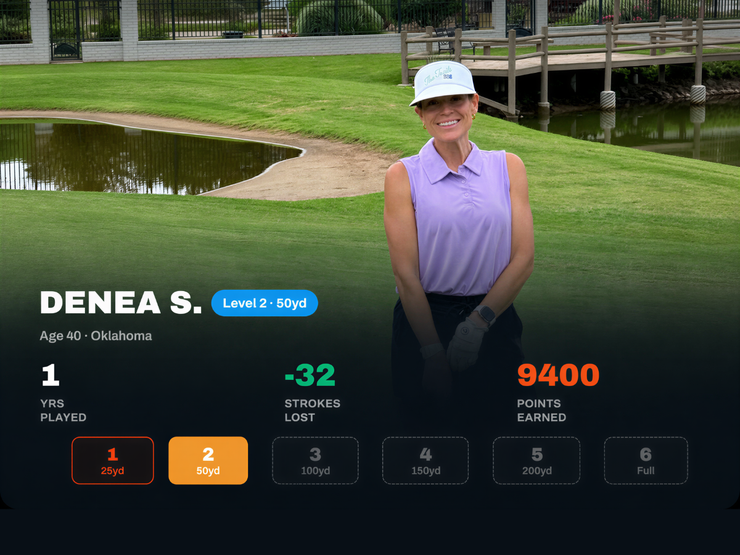
Denea started golf last year, at 40, in Oklahoma. One year in, she's taken 32 strokes off her scores and is in Operation 36 Level 2 - 50 yards.
Think about what that first day usually looks like for a woman picking up golf in her forties. A course full of people who grew up with it. A tee box that feels a mile long. The very reasonable suspicion that everybody is watching and nobody is going to explain anything.
Start her at 25 yards instead, in a group of people in exactly the same spot, with a scorecard she can actually fill in, and the whole thing changes. She isn't behind. She's on Level 2 with a personal best to chase.
That's a big part of why the women's side of Op 36 keeps growing. Not a marketing push aimed at women, just a format where nobody has to be good yet in order to belong. Adult beginner classes are full of Deneas, and a lot of them arrive because their kid started first and it looked more fun than sitting in the parking lot.
Coaches, this one is yours
Coaching good players has always come with a scoreboard. You make a small change, they go shoot a number, you know if it worked. Coaching beginners never had that. You'd finish a session, hope something stuck, and half the time never find out.
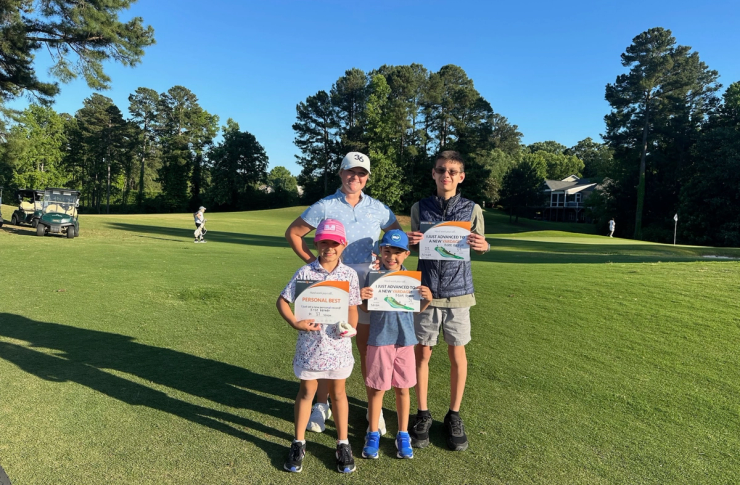
So a million strokes is really a million pieces of evidence that a coach somewhere built the right environment. Ran the class. Got a nervous first timer onto the course instead of parked at the range. Texted a family in March to come back in June.
"Anyone can teach a golf swing. It's much harder, and much more rewarding as a coach, to stick with a beginner through their first challenge, their first real scorecard, their first taste of actually getting better." Ryan Dailey, Op 36 Co-founder
Ryan calls those coaches believer builders, the ones who get people looking at a scorecard and seeing progress instead of pressure. And it turns out that has less to do with swing mechanics than most of the industry assumes.
"I can show you golf pros who know very little about technical instruction who are running some of the best programs in the country, creating golfers, just because they built the environment," Matt says.
Every stroke on the board belongs to a player who kept showing up and a coach who made showing up worth it.